


By: Lydia Crawley
The Parsons Advocate
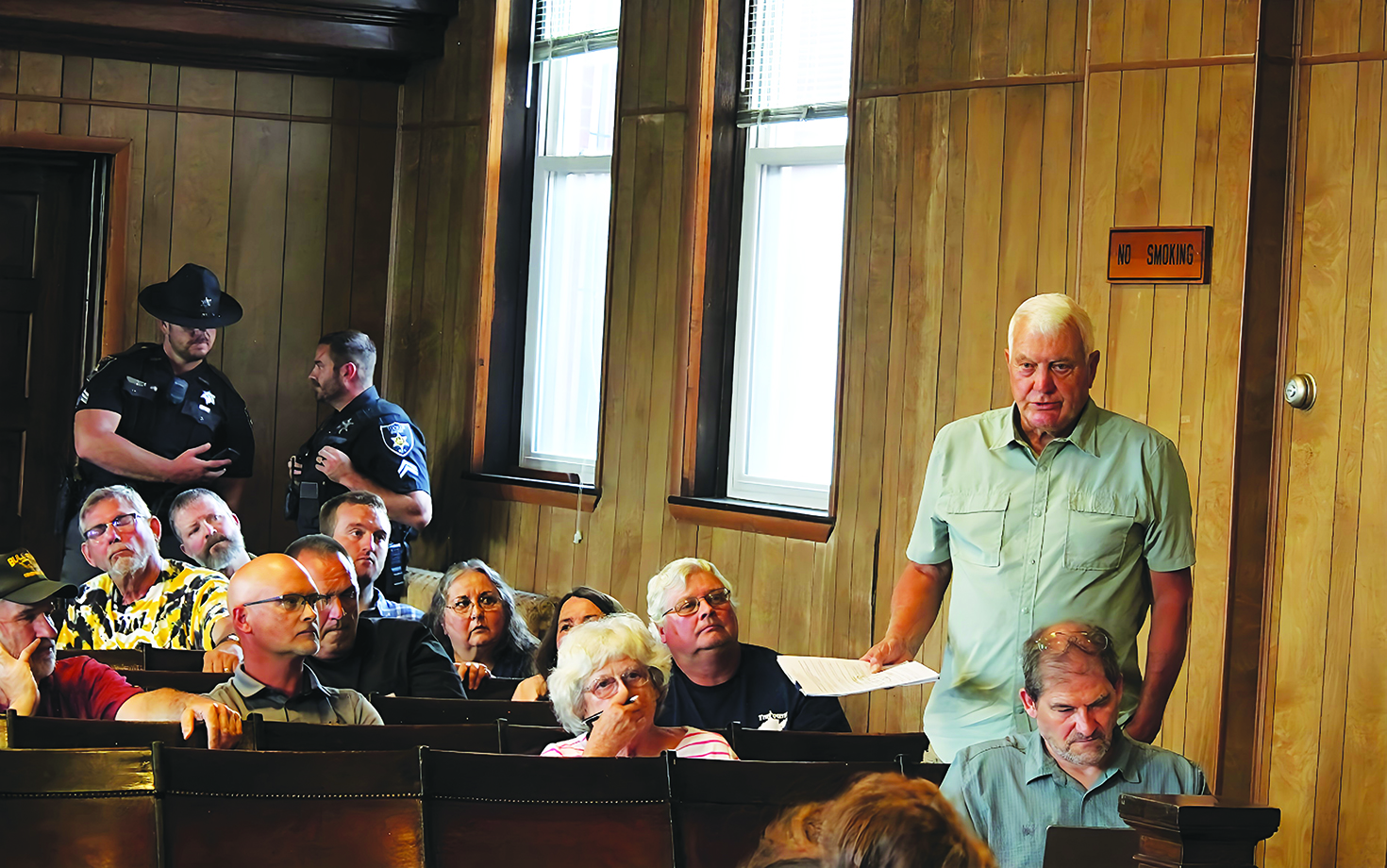
The Tucker County Commission unanimously passed a resolution before a packed house in the Tucker County Courthouse on July 22nd opposing the Valley North Transmission Project. The resolution declared the Commission’s support of private property rights and opposition not only to that project, but to the use of eminent domain for property acquisition in that project or any project similar.
Around 80 community members attended the meeting to voice their opposition to the project and to the proposed Ridgeline power plant project. Tucker County residents spoke on the impact the Valley Link project would have on their property.
Some residents, such as Jeremy Hile spoke on both issues. The Valley Link project will impact this property. He thanked the Commission for “taking a stand against it.”
“There’s plenty of public land that it doesn’t have to touch,” Hile said.
Courtney Phillips spoke of her parent’s farm, The Homestead the Valley North project’s impact, should the project be allowed to go through their generational farm.
“My family’s been here since the 1800’s. My parent’s live on a farm called The Homestead. The projected lines are supposed to go through their property, potentially taking where they live, how they take their money and my brother-in-law who lives there. I am opposed to this because I am not selling my heritage, my wildlife or my family.” – Courtney Phillips
Mr. Blakely spoke about his farm, Seven Islands Farm in Parsons. Blakely said the farm was deeded by a land grant from the State of Virginia, before West Virginia or Tucker County even existed. The farm, Blakely said will celebrate its Centennial this year.
“The farm has been a farm ever since that time. My son and daughter-in-law live there now. They have cattle and horses. They cut hay and raise a lot of vegetables. Standing in the yard right now you look down the river less than half a mile there’s a big power line coming across. Why do we have to have another major power line coming across all the private land there, when there’s government land it could be put on? But is seems like every time one of these things comes up, they don’t take government land, they take private land. Just like a lot of Corridor H. They avoided the government land and came in and took homes, people who have been here for years. My wife and I live here because we want to. We were raised here, went to school here.” – Mr. Blakely
Other residents spoke about how the proposed power lines would sit in their front yard. Where they now have a beautiful country view, should the project go through, the lines will run straight through their front yard.
The Commission passed a resolution titled “Resolution Supporting Private Property Rights and Opposing the Valley North Transmission Project and Any Similar Extra-High Voltage Transmission Corridor Affecting Tucker County” unanimously during their July 22nd session.
The resolution states that, “the Tucker County Commission finds that the burdens of another state’s energy policy should not fall disproportionately on Tucker County landowners.” The resolution also states that the Commission supports private property rights and with only 30% of Tucker County being privately owned, “the condemnation of limited private lands for out-of state energy transmission would disproportionately harm landowners, reduce scarce private land availability, diminish land values, and weaken the tax base.”
Under the resolution, the County affirms the following:
The Tucker County Commission formally opposes the Valley Link North 765-kV transmission project and any similar extra-high-voltage corridors through Tucker County.
The Commission opposes any route adversely affecting private property, agriculture, forests, groundwater, streams, wildlife, habitat, historic or cultural resources, communities, scenic viewsheds or long-term economic interests.
The Commission opposes the use of eminent domain for this project and affirms voluntary, non-coercive landowner negotiations.
The Commission requests complete GIS parcel overlays, all alternative alignments and independent environmental, agricultural, historic, groundwater, health, property-value and economic-impact studies funded by the developer and performed by experts acceptable to affected landowners.
The Commission requires meaningful public participation, certified notice to affected landowners and no less than one year for review and consultation.
The Commission urges PJM, the WV Public Service Commission and all agencies to fully evaluate alternatives, including maximizing existing corridors, reconductoring, grid-enhancing technologies, distributed generation, demand-side management and co-location within existing utility or transportation corridors.
The Commission reserves all rights to participate in administrative, judicial and regulator proceedings and to adopt additional resolutions or actions as appropriate.
The action raised a unanimous round of applause from the audience. The Tucker County Commission joins Upshur, Barbour, Lewis and Hampshire Counties in West Virginia, along with Frederick County, VA and the Clarke County Board of Supervisors and Berryville Town Council in VA, as well as the Weston City Council in opposing the project.